Saturday, August 3, 2013

Two thoughtful responses to my Riley Cooper blog on race

I received a number of comments about my blog of Thursday in which I suggested the Eagles should have suspended wide-out receiver Riley Cooper after he was exposed on a YouTube video using a an insensitive racial slur.

While the media uproar surrounding Cooper's remark still rages, I thought I would post two very thought responses to my blog. The first one is from my sister, Judy, who teaches theater at a state university in California. She brings a fresh perspective to the controversy because she sees the world through the lens of her education in theatrical. The second respondent, whose remarks appear underneath my sister's, wished to remain anonymous.    

 
From my sister, Judy:
 
I read your blog. Nicely done. Chuck, it seems that your reaction is historically based and a bit more theoretical, while your friend's response is more experiential - both entirely valid perspectives. I completely agree that CONTEXT is key here, and both of you make good arguments for the uses of context in a cultural and historical framework.
Here's my take from a performance theory perspective:
 
What I see as the biggest issue in Cooper's threat (and it WAS a threat) is his lack of awareness of his own privileged position as: a) a white man, and b) a superstar athlete.  To me, he is performing a role: a hyper masculinized bully.  He is clearly using his power (physical, cultural, racial) to get his way. He uses the derogatory term "nigger" to re-claim his status as superior/white man, and in doing so he is harkening upon our own cultural understanding of the term nigger.  His comments awaken in us (his audience) a multitude of responses depending on our own experiences with race, and possibly our level of education. His choice of words had an intention behind them. I'm guessing he was trying to humiliate his opponent, and win over some like-minded by-standers.  He used a term that we all know - that we all have a position on - for a very good reason, even if that "reason" was made in a split second.

Could we say that he was unaware of the power of his performance? Could we say that he learned these things in a locker room? Sure. But the bottom line is that as a white man he possess invisible privileges that he should be aware of. He also possesses a substantive amount of economic and social capital - far beyond that of the security guard he's addressing.  One might say - and this is where compassion comes in -  that he doesn't KNOW himself very well. Why? Because he hasn't been taught that whiteness is privilege. Why hasn't he been taught this? Because it is a very, very uncomfortable thing for us to examine given the complexity of race, class and gender in our country. There's always an experience, a "truth", that will eclipse the larger historical and social framework.
I think that we, as a society, create these performances. I think that we cast characters and ask them to perform roles, like the hyper-masculinized athlete/hero. We ask people to be losers or winners, to stay uneducated, to sexualize their own bodies, etc. So when something like this happens it reminds us that we need to ask for something different.


And this is the second thoughtful response, from an acquaintance who works in city services for the city of Philadelphia:
 
I read your blog post, and to a certain extent, I agree. But I take issue with a few things, not within the post itself; rather with cultural aspects surrounding "the N word" and how it effects society at large.

First let me state: words have power. The pen is mightier than the sword. That said, words only have as much power over you as you allow: in my case, when I was in 1st to 8th grade, the other kids called me 'contaminated' due to a physical defect I was born with. That hurt me greatly, and I still cringe when I hear it. But I don't let it rule my life; I've overcome the low self esteem that hurt caused me. I understand that my struggle is comparatively weak versus what that of the average African American encounters, but as much as I will never understand their struggle, they cannot understand mine.

Second: I take issue with the blanket statement that any other person that is not African American can ever utter the N word. It largely depends on context. Yes, it can be a hateful word; that said, it can be a term of endearment: I have, since I was 19, black friends that call me 'niggah' and are OK with me calling them 'niggah'.  So, it depends on context.

While I found Cooper's words to be hateful, ignorant and inappropriate in their context (white guy talking to black security guard at a Kenny Chesney concert, where presumably 99% of the attendees were white) I also have to consider his locker room experiences, in which I can only presume that 'niggah' is tossed about with abandon. So, as an NFL player, I really can't blame him for having that word in his vocabulary, inasmuch as I wouldn't blame Eminem for having it in his vocabulary as a rapper. It comes with the territory.

Where I work, the employee base is 30% white, black and hispanic, the remaining percentage asian. If I got offended every time I heard the slightest 'slur', for example, when two hispanics, speaking in Spanish, toss out a 'blanco y negro' (whites and blacks) in the elevator, I'd never get along with anyone. We're all people at work; we understand we come from different backgrounds, and we all know that part of our job is to represent our various communities. So long as there is a balance, it works. In other words: we're not really racist, but each person has a neighborhood agenda to promote. It is what it is, and we accept that.

Finally, while I realize that the scars of 400 years of slavery and another 100 years of Jim Crow institutionalized oppression are not healed,  I cannot lay blame entirely on society for the failures of the individual.

I don't know if you are aware of this, but, culturally, in the African American urban community, "Acting White"--studying, attending school, having a job, being responsible--is culturally frowned upon.  Furthermore, dependence on the 'system', i.e. public housing, food stamps, welfare, utility allowances etc. is strongly encouraged. Not that I am against programs that help the poor, but I do have a hard time reconciling people that depend on the system on a lifetime basis versus those that need it for a few years in order to get through some hard times.

The "Acting White" phenomenon is what makes friends of mine, that will remain nameless, rise to Masters-level education, or their nephew, who can solve complicated mathematical equations in his head and has to hide the fact he is a leader in his schools debate team: they have/will overcome white societies racism, and the urban black societies culture of willful ignorance and dependence.

So, what has happened over the past half century +/- 20 years is a culture of entitlement has developed. People that are talented and intelligent have, largely by peer pressure, not developed to their full potential. That has nothing to do with me, you, or Riley Cooper: but, it allows that kind of racial stereotype to propagate. As a cook I worked with at B Rathbones when I was 15 answered me when I, both innocently and ignorantly asked him, "what is a nigger?" He said, "A nigger is a lazy person." That's a definition of a word that I can live with.

Finally: if what Riley Cooper uttered, drunkenly, at a concert, is so offensive, it begs the question: what about the actual names of our sports franchises? I find the term "Redskins" patently offensive; the mascots and/or logos of the Atlanta Braves and Cleveland Indians are, without a doubt, racially based cartoons of the proud peoples that once inhabited our continent. People that our forebears came close to exterminating from the face of the planet. Hell, Braves fans do "the chop" with an accompanying/mocking cheer. Is that not at least, if not more so, as offensive as one player on one team uttering a drunken slur?

So: in closing, I think you have overreacted a bit much in calling for the dismissal of Riley Cooper. After all, he's only human. Just like the rest of us.


On Thu, Aug 1, 201

Thursday, August 1, 2013

Riley Cooper should have been axed: why the Eagles didn't do enough


Race will never stop rearing its ugly head in this country.

It's 2013, and the nation has had a mixed-race President for five years now. So, yes, we seem to be making "progress" in this divisive issue. But, as the brouhaha over Riley Cooper's insensitive and racist remark suggests, Americans continue to be bound to a terrible national heritage:  our centuries long, disgraceful, immoral appeasement with slavery. 150 years after Lincoln signed the Emancipation Proclamation, we still deal with its fallout.

We are frequently reminded of this lesson must be taught. Slavery was a detestable part of our history. It  turned Americans into monsters. We need to collectively, finally, fess up to this unforgiveable sin and all its implications. Caucasian Americans can never use a word as  hateful and divisive as the N-word. And we need to make our children understand it is not a word they can ever utter.

I'm willing to give Cooper credit for telling the public how embarrassed he is for his insensitive remark. His public apology at the Eagles training camp today seemed sincere and I really want to believe he will learn from his mistake. The truest thing he said in his public apology yesterday was "my parents didn't raise me that way. I embarrassed them." I believed him. And I feel much worse for them than I do for him. If my child did something like this I would feel eternal shame. I bet Cooper's parents will be feeling shame for a long time and they did nothing wrong.

I was also glad to hear Cooper say that the fact he was drinking was "no excuse." But I would have preferred he didn't bring the drinking into the conversation. By mentioning it, the implication was too obvious. The alcohol "made me do it; this isn't the 'real' me." When you watch the video, and hear the vitriol with which he uses that spiteful word; when you hear the anger in his voice, it is hard to imagine alcohol was doing any of the talking. Riley doing all the talking and there is no way around this: he sounded like a racist.

Jeffrey Lurie, said to be one of the most politically liberal owners in the NFL, should have acted with a firmer hand. Liberals tend to believe in second chances, and it is possible Lurie had that thought in the back of his head when he laid only a $37,000 fine on Cooper. (This was the most he could fine a player, based on the NFL collective bargaining agreement. Cooper is only making around $680,000 this season, so his insensitive comment is bound to hurt his wallet).

But it's also possible Lurie and his new head coach, Chip Kelly, had a heart to heart talk before Lurie made his sentiments known to the media. The Eagles slotted Riley Cooper as their number one wide-out as soon as Jeremy Maclin sustained a season-ending injury. The Eagles need Cooper to play if they want to enjoy a successful season. Therein lies management's dilemma. Pro football is a billion dollar business. There's a lot at stake in showing improvement this year. Lurie wants to give local fans a reason to root.

But I think he may have misread his fan base. Many of us would have been a lot prouder if the team simply cut Cooper, just to send a message: this is Philly, the Eagles don't tolerate racism. Anyone insensitive enough to use such a spiteful word cannot play in Philadelphia.

THAT would have shown leadership. It would have told the world something important: we who live in Philadelphia care more about promoting diversity, securing civility, than we do about corporate profits. Some things are more important that winning. Like loving you're brother, no matter what his skin color is. That's what "Philadelphia", in it's original Greek term, is supposed to mean.

As an educator, I plan on using Cooper's mistake as a lesson in semantics and in history. We must remind students in our classes why the N-word is so offensive. I watched "Roots" several months ago for the first time and I was appalled at how many times I had to hear that awful word during the show. When the TV series (based on the Alex Haley novel) first came out, Americans were not as sensitive to the nuances of the word as they now are. And the series provided a necessary service to white Americans who needed to understand the context of the word and why it is so vile to black Americans. "Roots" was a graphic display of exactly what the word meant. It means a lot more than just the enslavement of dark skinned people.

A person born into slavery had no freedom. You were a thing to be owned. You were not your own person. Your master was entitled, in the legal meaning of the word, to use you however he wanted. Your children were his, too. He could punish you with impunity. He could ask you to perform any demeaning thing he wanted you to do, including having sex with him. Rape was legal and common. If you disobeyed him or objected to being raped, he could beat you. If you died from his whippings and beatings, there was no public outcry and no legal recourse to his murder. When a slaver owned you, your body was his to use. The most common word slavers used to describe the slaves they owned was the N-word. It was universally used with contempt and degradation.

We, as educators, must make students understand that any Caucasian who calls a person of color the N-word is crossing a line that is egregious and hurtful because of the original historic meaning in which the word was used. I have no problem with blacks who use the word as a term of endearment. I wish they didn't because too many uneducated people believe the word has become "acceptable" when they do. But if their use of it can somehow ease some of the hateful implications of the word, if their use of the word helps to remind the rest of us it's off limits, that's a good thing.

This is what the N-word implies: hundreds of years of bondage. Murder. Lynchings. Whippings. Rapes. The total degradation of an entire race of people. There is nothing good in it.

Riley Cooper didn't invent the word. It's been around for centuries, just like hatred itself. But if the Eagles dismissed him for the season for his insensitive remark, I can almost guarantee you this: no white player would ever risk using it again.

We would all have something to thank Cooper for then. And most of us might even be ready to forgive him. Even his black teammates.

Tuesday, July 23, 2013

"It's Too Late to Stop Now!" -- Van Morrison's performance at the Rainbow Theater happened 40 years ago


It's Too Late to Stop Now

Every life has some days that seem to bend time. Days that not only linger in our memories long after the sun as set but that take on a life of its own. They defy logic or expectations. They are so good they must have happened to someone else.
Only they didn’t. They happened to you. Really.

You have to remember it, don’t you? How could you not? The memory of it has carved a deep gash in your soul. It’s as much a part of you as your right hand.
Stealing into game 6 of the World Series in 1980 with my brother Paul was one such day. And playing softball against Bruce Springsteen in the summer of 1975, well before he became an American megastar, was another. I’ve told those stories many times to many people. They always bring a smile.

This is another such day and it’s a story I mention less frequently. But in its own way, it’s just as iconic as seeing your childhood team win the World Series in person or meeting your favorite rock star on the field of competition in a friendly ball game.
After graduating from Loyola University in New Orleans, I flew to London in the summer of 1973 to take a six-week graduate course in “Modern British Fiction” in early July. When I landed at Heathrow, grabbed a glossy weekly called “Timeout,” devoted to pop culture and critical commentary.

I casually flipped through the magazine and came to an ad that immediately caught my eye. “Van Morrison, live at the Rainbow Theatre! July 23rd and 24th!” was the headline. But in thick, 60 point block letters, stamped over the headline were these soul-wounding words: “SOLD OUT!”  My heart sank.
Van Morrison was coming to London!!!!  Besides the Beatles or the Stones, there was no one I wanted to see perform more than Van the Man. He’d released a series of astonishing recordings around this time, including “Astral Weeks”, “Moondance” and “Tupelo Honey”. The three of them constituted part of the soundtrack of my college years and they’d become deeply imbedded in the fabric of my teenage psyche. I had to try to see him. I stored the dates away in my mind and waited for the concert dates to arrive.

On the evening of July 23rd, I walked through the university cafeteria seeking someone to take a tube ride with me down to the south side of the city to try to see Van. To my astonishment, none of the London U. students I knew were eager to queue up in a standing room only line for two hours before the show. A few of my summer acquaintances knew the performer’s music, but none were as infatuated with his brand of Irish soul music as I was. 

One fellow, a Nigerian student named Alfa, overheard me asking the others about Morrison tickets and he said he would go with me if I would wait until tomorrow. He had some studying to do that night….but he invited me to come to his dorm room after 10 and promised we could listen to “Astral Weeks” and play chess. So that’s what we did. He dropped the spindle over the record and “Moondance” never sounded so good. Van was in London! He might be playing this very song even as we listened to it in Afra’s dorm room!
I don’t recall who won the chess match. It required listening to two of Van’s albums to get through our game. But by the end of the evening, Afra’s record collection had worked its magic on me. There was no way I was going to miss Van Morrison the next night.

When I grabbed a copy of the London Times at breakfast, the paper’s rock critic had written a glowing review of the first night’s show. The Times’ critic compared Morrison’s performance to the kind of funky spontaneity of the Band’s best live performances. That comparison and reference hooked me. I had to go.
Afra and I took the tube down to south London, where the Rainbow was located. The train was packed with long-haired flower people who had the same intention as we did. We asked everyone we saw if they had extra tickets for sale. One wag said he had one but his asking price was seven pounds, a price that seems exorbitant to me at the time (equivalent to $18 U.S. dollars when $5 was a standard rock concert price.) It would have been a bargain had I paid it. I didn’t know that at the time.

When we stepped off the underground, the exterior of the Rainbow Theatre was a carnival scene. The smell of marijuana wafted through the dank summer air and “brown-eyed girls” tossed Frisbees in the middle of the street, long tangles of shaggy hair cascading down their backs; their necklace bells chiming brightly as they ran after errant tosses.
Afra and I headed for the front of the concert venue looking for the standing room only line but we suddenly stopped cold. The queue was a mad scramble of pushing and shoving fans, fighting to get near the front of a small door on the side of the theatre. The price of admission was only two pounds, but already more than 200 people were in line. Afra shrugged his shoulders and started walking down the long line shouting out “Who has tickets!??!”

Despairing, I headed in the opposite direction and found myself under the Rainbow’s awning, staring through the glass doors of the auditorium at the lucky few who were already mingling inside. This dark haired kid about my age chose that very moment to come out of the theatre. We stood there looking at one another, confused by the circumstances of the moment. I knew him. He knew me. But how? Where had I seen his face? Who was he?
Then it came to me. His name drifted out of the subconscious depths of my head. Dyer O’Connor. But how did I know him?

“Hey,” he said. “Don’t you go to Loyola? Weren’t you in American History with me?”
Yes. I was. I must have been. That’s how I knew him. “What are you doing here in London?” he wanted to know. I explained I was taking a summer class at the University of London. That I was a big fan of Van Morrison but the tickets to the concert had been sold out before I landed in London. I was hoping to snag a scalped ticket.

“I have one for you!” he said. “My date canceled on me.”
I looked over my shoulder for Alfa. He had disappeared into the anxious throng at the standing room only line. Meanwhile, I had joined the lucky few. I passed through the doors of the Rainbow Theatre with Dyer O’Conner, a guy I barely knew. He held an extra ticket in his hand and passed it over to a tuxedoed teenage ticket taker with bad teeth.

I reached for my wallet to pay for it. “No.  No worries,” Dyer said. “My treat. Glad for the company. Glad to give it to a Van fan.”
 
Our seats were in the balcony, not more than eight or nine rows from the rail. The Rainbow had been designed as a gilded palace of Hollywood films in the early 1930s and was called the Astoria Cinema. Crystal chandeliers hung from the ceiling, if memory serves, and replicas of Greek statues were situated in nooks on the interior walls of the theater. It looked a bit like the Tower Theater in Upper Darby. Our seats were comfortable but covered by faded red velvet, worn down over time by the fannies of thousands of moviegoers.


The movie palace had been converted to a musical theater only a few years before. The Who played the first rock show there in December of 1971.  Eric Clapton, Queen, the Sweet, Little Feat and Bob Marley and the Wailers all recorded live album there in the mid-‘70s. The venue is also believed to be the first place Jimi Hendrix burned a guitar on stage.

Dyer and I spent a few moments getting to know one another, trading tales about our Loyola experiences. His dad worked for Exxon in London so London was his home when he wasn’t in New Orleans. We were both chagrined to have spent four years in the same class at a school without ever having a conversation until that serendipitous meeting at the Rainbow. He’d majored in history. I majored in journalism, so our paths didn’t cross much. But we recognized one another immediately when he stepped through the doors of the theater.
A journal I kept of my trip to Britain that summer has this entry for July 24th: “I can’t really remember what songs he did. Some from the new LP, Hard Nose the Highway. Also, “I Just Want to Make Love To You” – “Brown Eyed Girl,” “Gloria” – “Moondance” – “Caravan” – “Everything” -- “Wild Night” – “Moonshine Whiskey” – “Domino” – “Gypsy” and three encores. He finished with “Listen to the Lion” ….It was his first London appearance in eight years and I got to go! I still hardly believe it!”

The band Van brought during his summer of ’73 tour was called the Caledonia Soul Orchestra. It was not a standard rock quartet. The bass, lead guitar, piano and drums were complimented by horns and strings: a sax and trumpet player; a trio of violins, a viola player and a cello player.  The ensemble played Morrison’s own compositions with delicate finesse. But they wailed on a series of blues tributes Morrison sung to the American R&B heroes of his youth: Ray Charles, Sam Cooke, Willie Dixon and Sonny Boy Williamson.
The Rainbow concert seemed to teeter between two contrasting styles of music: the airy, light touches of “Warm Love” and “These Dreams of You” (which highlighted the delicate playing of the strings) and the brassy bombast of “Gloria”, “Wild Night” and the blues tributes. I had seen Morrison perform 18 months earlier at the Villanova Field House with a much different band. He was nervous that night, unsure of himself. There were times he seemed afraid to even grab the microphone. This may have been just part of his “act” but Morrison has a reputation for being temperamental in his live performances and the uncertainty of his show at Villanova seemed to be part of the man, not part of an act.

His bearing at the Rainbow was much, much different. He was confident, not just a performer but a conductor. The performers backing him were in close orbit with him and he directed them with a casual nod of his head or a sharp glance. I had never witnessed any concert, any performance, quite like it. He held the audience in thrall and, during some quiet moments in the performance, the performance felt like a church service. The  audience began to engage the performer in call and response and small talk.
Late into the show, with the smell of marijuana hovering thick around us, Dyer pulled out a joint, lit it and passed it over to me. “Here,” he said, “try this. It’s from Kenya.” I drew a long hit and passed it back. We took turns until it became a tiny glowing ember that Dyer crushed under his boot heel. I knew instantly I had never smoked anything nearly so potent before. I had been given a very smooth and potent form of herb. I wouldn’t share this recognition of something so great, so potent, until I tried a 12-year old single malt scotch, aged in an oaken cask, when I was in my mid-40s. Dyer’s weed was better.

If the music hadn’t already transported us into the mystic, the potent weed surely did. Suddenly we were not just listening to music, we were into the music. It wasn’t that I was suddenly stoned. Really. But a revelation struck me. We -- me, Dyer and the entire audience – had become part of the performance. Van wasn’t just in tune with his backing performers. He was tuned into us, too.
There were some moments, during his final tune, “Cypress Avenue” when the silence became too much for the audience to bear; when Morrison seemed to be waiting for someone to give him a signal to perform. This happened on several occasions during the journey of this amazing song. The effect felt magical…. And you can hear it if you listen to the song on “It’s Too Late to Stop Now”,  a recording of this concert that was released in February of 1974.  

 
About halfway through this epic version of “Cypress Avenue”, which goes on a mind-bending journey for 10 minutes, Morrison sings a phrase that I still hear as “And they say in France!” Then he pauses. I am uncertain if this is precisely what he is singing or not. Some wags in the balcony call out to him “France!” I was stoned, I know, and I have no proof of this except what I hear on the record, but I swear it was me and Dyer, feeling the effects of his Kenyan stick, shouting down to the stage from our balcony seats. He repeats the verse: “And they say in France!” We, now joined by half a dozen other emboldened (possibly stoned?) members of the audience, shout back the invocation: “France!” Morrison does his lyric a third time. One more time “France!” comes back to him.
About two minutes later someone shouts down from the balcony, “Cook, Van, cook!”  And about a minute after that someone else calls out to him: “Turn it on!”  Van hesitates ever so slightly after hearing this and makes the crowd wait impatiently for him to continue the song. He bends low, gripping the microphone and savoring the moment, milking it for all its worth, before he finally chuckles: “It’s already turned on”. The concert stops while a roar of appreciative hilarity commences to endorse his quip.

Morrison, in complete command of both the audience and the moment, improvises a short series of vamps and tossed-off asides to the audience before his locomotive of a band crescendos in a heightened, audacious wall of noise that ends with Morrison shouting out his signature phrase at the climax of the song, giving his album its name: “It’s too late to stop now!” Then he exits stage right, striding like a lion.
It was a moment – a concert – I can never forget. Of course, having a record of the concert makes the details easier to assimilate and provides me with other half-remembered details of that eventful evening. When the record came out seven months later, I was back in New Orleans. I had long forgotten how buzzed I was when Morrison began playing “Cypress Avenue”.  But when the needle hit that part of the record where Dyer and I shout out “France!” I realized I had become a tiny thread in a magnificent quilt. I could hear myself on “It’s Too Late to Stop Now”. 

 
In the years since July 24th, 1973, “It’s Too Late to Stop Now” has become regaled by critics as one of the greatest live performances of the rock era. Half of the songs on the two-discs are not songs I can remember hearing and were likely recorded in Los Angeles in June of that year. Because of the breadth of the material on the record – it covered songs from his most creative artistic period in the late 1960s and early 1970s; those five nods to African American R&B singers and hits from his days with Them -- it was considered a vital overview of his career up to that point. But it also showcased Morrison at the peak of his powers as a singer and the defining document of what Morrison himself called “Celtic soul”.

I knew I had heard something remarkable that night. My intuition was confirmed when I picked up a 1979 book called “Stranded: Rock and Roll for a Desert Island” edited by Greil Marcus. Its central conceit was this: if you were stranded on a desert island and could only bring one album with you, which one would you bring?  The book’s second essay was by the arts editor of the Village Voice, a woman named M. Mark, who chose “Too Late to Stop Now” as her desert island disc.
It’s not the disc I would bring to an island if I could only bring one….but only because I don’t need to hear it again. I’ve committed it to all to memory.

Dyer and I took the tube back to northern London, chatting about our recollections of what we had just witnessed. I have little doubt the underground was filled with other Van fans, nodding their heads in stoned inebriation, just as blown away by what they had witnessed as we were. We got off at different stops and I was sure I would see him again before I left London. I didn’t. And when I got back to New Orleans, I lost his address, scribbled on the back of the July 24th Rainbow Theater concert ticket.  
But his act of kindness and generosity was something I never forgot. And every time I played the album, in my home or on my car CD player, I remembered sharing both that concert with him and the most magnificent weed I have ever experienced.

I wanted to talk to him before I published this story. I hoped he was still alive to thank him. I looked for him on Facebook without any luck. I Googled his name. Nothing turned up. Finally, about a week ago, I contacted the alumni office of our alma mater. A helpful woman named Monique tracked him down and sent him word that I wanted to talk to him. But due to what she called “privacy issues” she couldn’t give me his phone number or email address. She said she had tried to call him but noted “he didn’t pick up. He probably thought we were asking him for money.” She wanted to know why I wanted to talk to him, so I gave her a short email version of this story, which she loved reading.
About two days later, my cell phone rang. It was Dyer. He is retired from the oil business (his dad helped him land a job in the industry) and lives in Colorado now with his wife, Boo, who he met during his first week at Loyola.  She, he told me, was the “canceled date” that allowed me to have a seat at rock history’s table.

When I asked what he remembered about the show, he told me we were sitting in the balcony, stage right. He sounded good…although he did not remember yelling out “France” during the show. He said he still goes to a ton of concerts, many of them at nearby Red Rocks, a stunning Colorado concert venue.
And yes, he still smokes weed.

“Colorado was the first state in the union to legalize it,” he proudly noted.
I haven’t imbibed marijuana in many years, but when I next get out to Colorado, I know a guy who will gladly share a stick with me. And I bet I know what album he’ll put on the turn table.

Tuesday, June 25, 2013

June 24, 2013, a night Downingtown won't soon forget


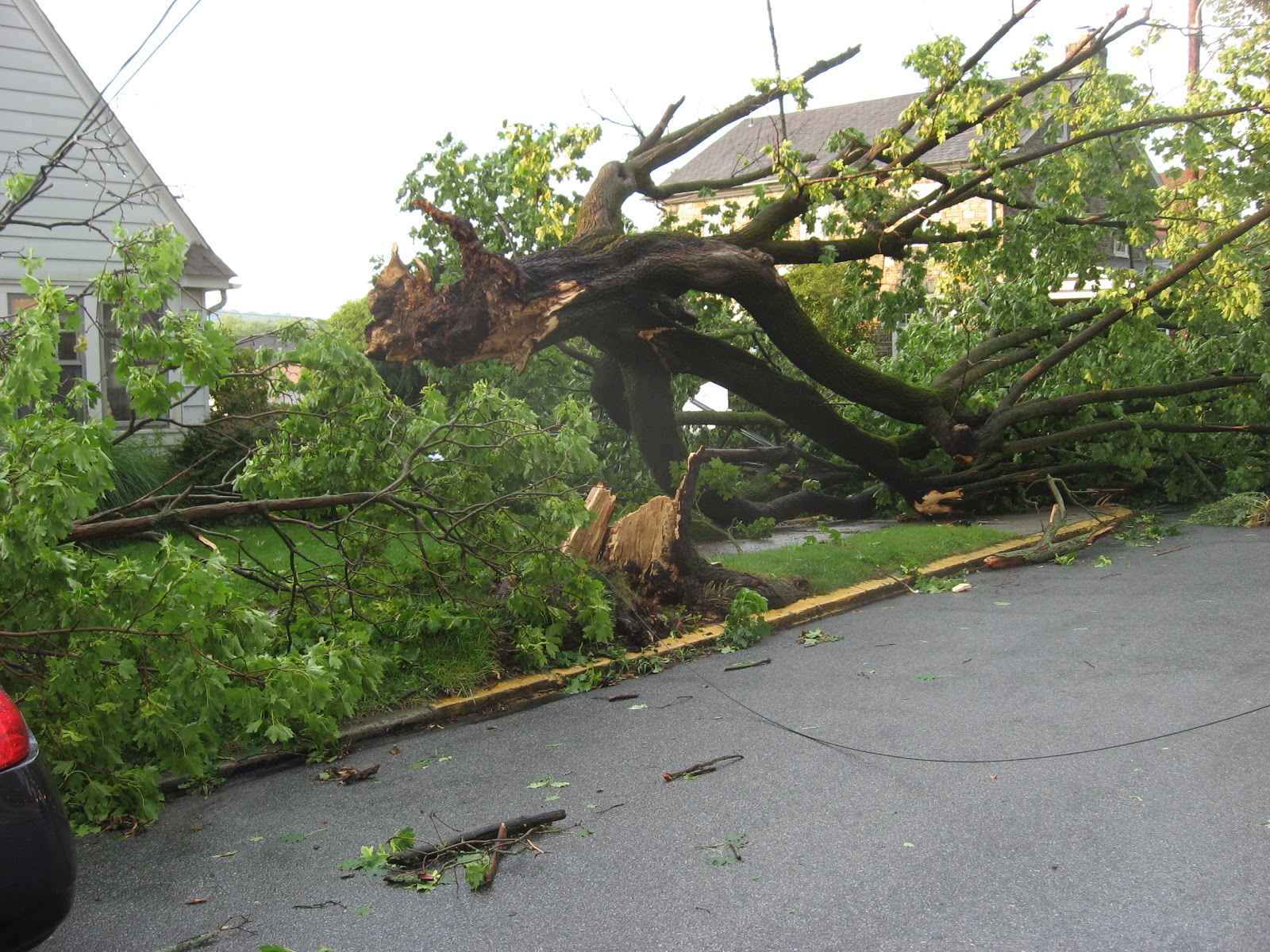
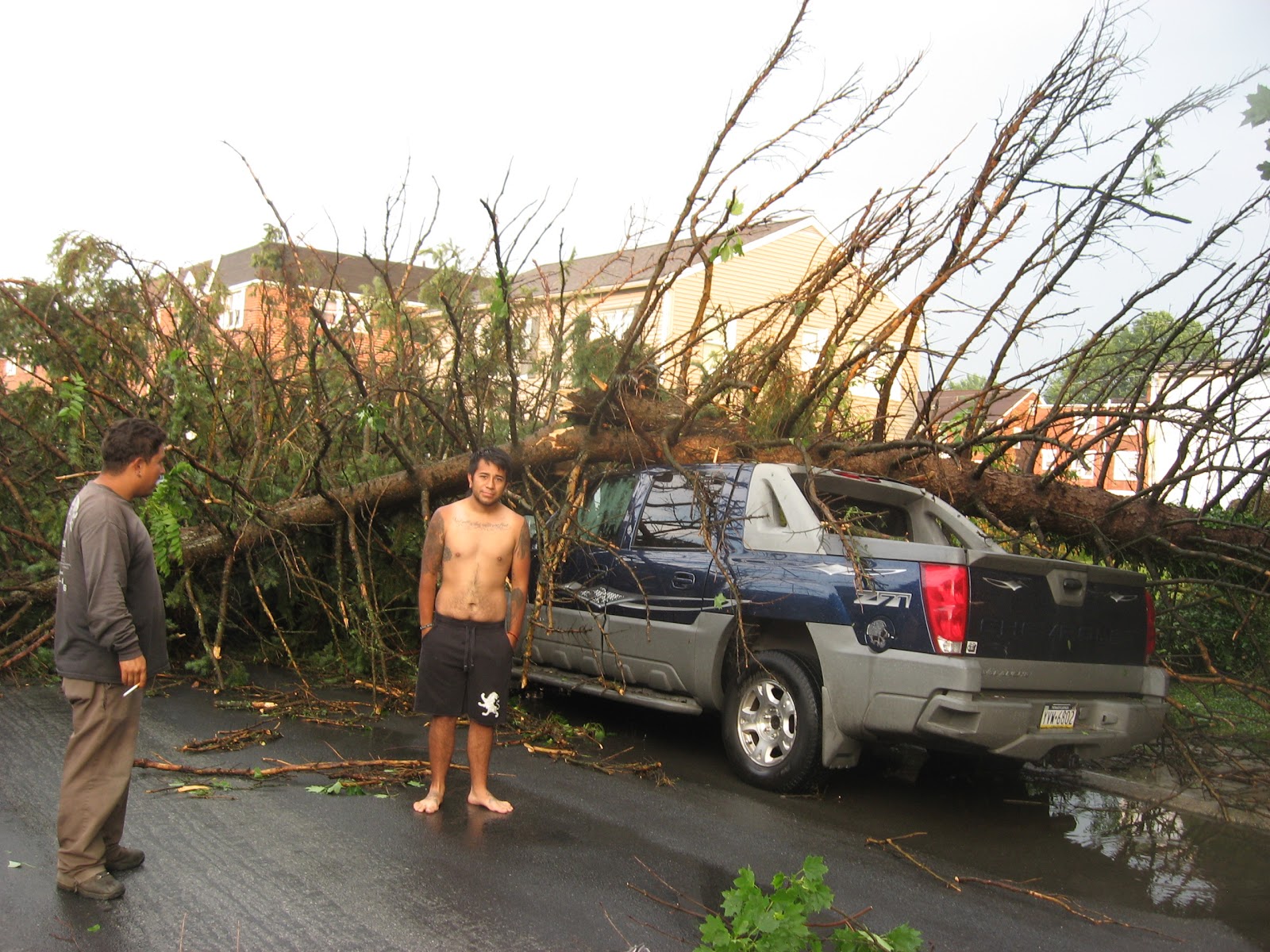
A wind storm ripped through my Downingtown neighborhood last night, right after 6 p.m. It felt like being in the middle of a hurricane for about five minutes. (I lived in Louisiana for eight years, and I can honestly tell you the comparison stands up, except that no hurricane I've ever been in only lasts five minutes).

Six or seven peels of thunder and nearly as many visible lightning strikes called my attention to the front porch of the house. When I poked my head out of the door, rain was slashing down in long diagonal sheets and the yaw and cracks of wood splintering augmented the sounds of the lightning. It was hard to know which sound was which.

I bolted upstairs to close my bedroom windows and the rungs on my floor were already soaked. I went through the house as fast as possible, closing all windows. Everywhere I turned, water was coming in through my screens. I felt like a deckhand on Noah's ark. I wished I had remembered to record it with the Flipcam. The footage would have been hard to believe. You had to see it for yourself.
 
I secured the window locks and ventured a peek outside my front door. A huge limb from the maple in my neighbor's year had been ripped from the trunk and was now covering most of his front lawn and some of his front porch roof. I felt relieved that it had done no  structural damage to his house...and I was glad the limb had not crushed my Ford Taurus, which was parked on the other side of the tree.


The thought occurred to me the car might be in some jeopardy, what with limbs being severed and (a glance across the street told me) tress being ripped from the Earth by their roots. The lightning flashed and the sonic booms they made kept me inside for a few more minutes.

Finally, I made a break for the car, determined to move it down the street, away from the tree. I was drenched within two seconds. When I started the car, I couldn't see. It felt as if I was trying to glance through a waterfall. The wipers were useless. I knew I had to drive around a fallen electrical wire to get the car to a safer spot.  I wondered if this plan to save a 2003 Taurus with 140,000 miles on the odometer was such a good idea. I did it anyway and ran back into the house soaked to the skin. By the time I had toweled off and changed my clothes, the sun was out. The entire environmental catastrophe took about 10 minutes.


I ventured out into the street with my camera to record the mess. Neighbors were already congregating and shaking their heads in collective wonder. The sentiment du jour was "Wow! What was that!??" Except the language was considerably more colorful and F-bombs flowed freely from nearly every mouth. "Did a tornado just come through here?" No one saw any funnels, so that seemed unlikely. We were all awestruck. My block lost two great old trees, including one about 20 yards from my front porch that barely missed landing on the roof of neighbor's house. I knew instinctively I was sitting on a story and I needed to alert the local newspaper about it.

My friend, the editor of the Daily Local, Andy Hachidorian, was already gone for the day but the city desk had not heard anything about the storm when I called. I told them to please get a reporter down to my block but that I would also take some pictures on my digital camera and bring them to the paper within an hour..

Taking dramatic pictures of nature wreaking havoc on a neighborhood was never so easy. I reeled off about 30 pictures in 30 minutes, some of them recorded here on the blog.

The electric was out, of course. The limb that tore off my neighbor's tree also brought down the electrical and telephone wires. I knew it would be impossible to email the pics to the Daily Local. But I decided it was worth a seven mile drive up Route 322 to West Chester. The guys in the newsroom were happy to have them, although there was some glitches with the SIM card download.

It had been many years since I had a front page photo credit so I was happy to see my work on t he DLN front page this morning when I went to the local Wawa to grab a coffee and paper.

Last night, sitting in the midst of the darkened neighborhood, I slowly sipped and emptied two Weyerbacher beers and smoked a Nicaraguan cigar on my front porch. The night was cool and calm. The neighborhood had taken a beating but everyone was adjusting to life without the maples on our street and some folks were out surveying the damage with flashlights and whispering amazements. 
.

No one was killed. That was best part. But we all went to bed without the benefit of air conditioners or ceiling fans, knowing that Mother Nature had handed us a friendly reminder that you can't ever take anything for granted. Even suburban, sleepy Downingtown had occasional moments of sheer panic and provocation.

Thursday, June 20, 2013

mid-year pop music report: the best of 2013 so far


Eleven pop music compact discs worth finding:


Daft Punk – “Random Access Memories -- “Random Access Memories” sounds like a big, meticulous studio statement and it showcases a painstaking attention to sonic detail that bands like Steely Dan, Genesis and Pink Floyd brought to their recordings in the 1970s. If it sounds tad too tricked up for your ears, give it time to grow on you. “Get Lucky,” the CD’s hit single (you may be a little sick of this one already and I wouldn't blame you!), owns an irresistibly danceable beat taken straight out of the Nile Rodgers playbook, (no big surprise as Rodgers is listed as a collaborator on the liner notes). But “Get Lucky” is just the gleaming icing on the disco layer cake. The rest of the disc requires repeated listening to appreciate the ambitious reach of this great band and their most original and daring recording to date.


Sallie Ford and the Sound Outside – “Untamed Beast” -- This Portland band sounds like punks who grew up listening to rockabilly and Charles Mingus. And Sallie sings with a swagger that’s sexy, sultry and natural. The All Music Guide described her vocal performances like this: “With a voice that can belt, soothe, caress, and flat-out spit sass, attitude and raw street emotion, she sounds like a dream cross between Ella Fitzgerald and Janis Joplin.” Songs to download: “They Told Me”, “Bad Boys” and “Do Me Right”. But be sure the house doesn’t burn down while you’re listening.


Patty Griffin – “American Kid”  -- I’ve been a sucker for this Maine singer-songwriter since first hearing “Living With Ghosts”, a stripped down 1996 acoustic set of poignant vignettes that plumb the depth of love, loss of love and family life. Her latest collection is reminiscent of that initial effort, songs that detail her relationship with her father. They were written shortly after learning of her father’s impending death and explore his impending absence in her life. Her new beau, Robert Plant, sings background on several of the songs, most notably “Ohio” and “Faithful Son.” Americana’s finest recorded moments of 2013.  


Iron & Wine – “Ghost On Ghost” -- It can be hard to handle the earnest yearning of Sam Beam’s  warm as oatmeal vocals on occasion. But this year’s Iron & Wine effort sounds like a nod to Van Morrison’s “Astral Weeks/Moondance” era. Beam’s baritone is backed by a blend of soulful horns and augmented by the thrum of acoustic bass, violins and tasty female background vocalists. His singing feels lighter and more carefree this time around. Standout cuts include “New Mexico’s No Breeze” and “Grace for Saints and Ramblers.” 


Laura Mvula – “Sing to the Moon” – On her first full length CD,  newcomer Laura Mvula channels Nina Simone’s special brand of soulfulness.  From the first notes of this marvelous debut, the UK singer uses deft, velvety vocal textures as counterpoint to jazzy arrangements that create the intimate vibe of a late night club scene in Harlem, circa 1950. Keep an eye on this rising R&B/soul singer.  Stardom feels inevitable.


The National – “Trouble Will Find Me” -- The National is a band that found a winning formula on 2010’s “High Violet” and they follow the same sonic formula on this year’s disc. Nothing wrong with that, because “Violet” was one of the year’s crowning achievements in pop music. If it feels a little bit like they’re treading water, it’s hard to imagine their fans will mind. Matt Berninger’s  baritone always  adds buckets of gravitas to lyrical revelations that can be knotty and labyrinthian. The songs that work best this time around are “Humiliation” and “Pink Rabbits” (a drink he invented).


Parquet Courts – “Light Up Gold” – Fifteen kick ass songs in just 33 minutes. Not one of them feels like filler. This Brooklyn rock quartet (they originally hail from Texas) take the lo-fi aesthetic of Pavement, the Feelies and Guided By Voices to new heights and turn that 1990s template into something that sounds fresh and original. Songwriter Andrew Savage’s wry observational takes on politics, pop culture and personal relationships suggest he spent more than a few months of his teenage years listening to Jonathon Richman.  Start with “Stoned and Starving” and “Borrowed Time.” Let the slacker angst wash over you. Revel in the innocent glory of a garage rock band finding their voice.


Red Baraat – “Shruggy Ji” --  Red Baraat takes its name from the Indian wedding ceremony in which the groom, joined by his friends and family, walk to the bride's family's dwelling to pick her up – all the while accompanied by a rollicking brass band following behind. If this sounds faintly like a rejiggered New Orleans street tradition, well so does Red Baraat. Led by Sonny Jain on dhol (a large drum that Jain wears on a strap over his shoulder), the Brooklyn collective is a fusion of brass-heavy New Orleans jazz, bhangra funk and Indian wedding music. If there is any “fault” at all it’s that the studio album does not measure up to the band’s live performance. Don’t miss them if they’re playing within a 50 mile radius. You’ll smile for days afterwards. Irresistible and imminently danceable.


Frank Turner – “Tape Deck Heart” – Former front man for the British punk band Million Dead, Turner turned to a more tradition band of Brit folk rock later in his career and has released a string of near great CDs that mine the same territory as Billy Bragg, whose liberal politics provide a nifty template for Turner’s own voice on “Tape Deck Heart.” “There Is No God” stakes a riotous claim for atheism and the celebratory “Recovery” makes addiction sound like a necessary part of living a full life. This vastly underrated artist deserves attention and this CD is one of the hidden gems of the year. 


Satellite Hearts – “Imperial Green” – This power pop trio from the Philly area released "Imperial Green" at the end of 2012, but I had to include in the mid-year rock report. Inventive and brash, the Hearts sound like a mash-up of Brit ‘70s rockers Thin Lizzy, T-Rex and the Clash. For a band comprised of guys in their teens/early 20s, they play with surprising assurance.  Their wall of sound approach has been used by many bands, but few make it work this well. “Dumb Down Daisy” and “Substitute” sound like the stand-out tracks to me, but the whole shebang works so well it’s hard to find the best of the best. 


The Will Callers – “What Else Is Left?” – If you like your alt-country ballsy, loud and with a slathered side of greasy greatness, you’ll dig the Will Callers, Fort Worth’s finest. Produced by Ray Wylie Hubbard (the bespectacled Texas hippie whose “Grifter’s Hymnal” topped my best of the year list last December), this just released CD is shot through with gunslinger attitude.  The band earned a statewide Texas rep by winning the Shiner’s Rising Star contest in 2010. This is their first full length studio CD and marks them as a band to watch carefully in the near future. “One Single Tear”, “Weight of the World”, “Heart Like Mine” and “87 Miles” will rock the house.


Wednesday, May 22, 2013

A report on my visit to Wisconsin to see my Mom


I landed in Milwaukee around 9:30 on the morning of Thursday, May 17 and rented a car to drive up to Oshkosh to  see mom. It was raining torrentally hard for about an hour but I got to Oshkosh, where my mother resides, the weather settled. I arrived at her care facility, Evergreen, right after  lunch. It took a few minutes for the memory cells to click in, but after just a little while, Mom seemed to recognize me. Although she cannot function much, in terms of walking or even feeding herself, she seemed more lucid than the last time I saw, at Thanksgiving in 2011, not long after my dad passed. I remember thinking to myself when I left my sister Heidi's house that bleak November day I would not see her alive again, so seeing her well and in good spirits was an unexpected blessing.

The rain had let up by the early afternoon and I took mom out in a wheelchair for some air. We found a spot near the pond by the Evergreen facility and within a few minutes a large bass leaped out of the water to catch a wayward fly. "There goes Dad, Mom!" I said to her. She laughed when the fish splashed down. "Soon you'll go see Dad in heaven, Mom!" I suggested to her. She looked at me and shook her head. "Noooooo!" she said. I don't think Mom is all that ready to pass.

We had one other stroll later in the afternoon but it was short-lived -- the wind kicked up and it started to rain again. I stayed until dinner, which mom ate at the table with several other elderly women patients. This part of my visit was heartbreaking. The nurses at Evergreen engage the patients a lot and it pleased me to see how good the care is there and that many of the nurses  know Mom by name and appreciate her. But there is no interaction at all amongst the women at mom's dinner table when they share meals together. This is inevitable and not likely to change, but it saddens me Mom is not closer to my East Coast siblings because she would get so much more attention and interaction from us, even if we only saw her once or twice a month. The hard reality of the flipside of that scenario is we would not find such an amazing place as Evergreen....so Mom is in a good place for the remainder of her life with people who take care of her and appreciate the how special she is.

I made a photocopy of the story that appeared in the Philadelphia Inquirer on Mother's day in 1984 ("The Civil Disobedience of an American Mother") and gave it to Teresa, one of the night nurses on Thursday evening after dinner. She was immediately taken with my mom's political activism when I gave her a short synopsis of the story and she promised to photocopy it and pass it around to the other caretakers. I had some doubts whether this would happen but on Monday, when I spend 4 hours with mom before driving back to Milwaukee, one of the day nurses asked me if I was Chuck and then proceeded to pump me with questions about Mom and her acts of civil obedience against the nuclear arms race. She recommended my story to a number of other nurses at Evergreen, so mom will get some extra special attention from the caretakers there, at least the one's who appreciate what Mom stood for and did with her life.


 Heidi and Michael took me out to a fish-fry dinner at a local restaurant near Neenah and we got all caught up on things at Kimberly Clark. Both of them have great careers going on, but Michael was somewhat chagrined that he is becoming better known at work as "Heidi Hopkin's husband" than for his own sure-handed management.

On Friday I was at Evergreen from 9 a.m. to 6 p.m. The day was sunny and warm and I took her outside on three different occasions, once for a long stroll through a wooden glen/walking path near the pond. She loved being outside. There were several rows of tall, blooming tulips planted in a small garden outside of Unit 8 where Mom lives and Mom took note of them when I wheeled her past them. When I asked her if she remembered tulips from Holland, she said "Oh, yes." I was pleasantly surprised she was lucid enough to process and answer my question.  When mom took a nap after lunch, I took a ride into downtown Neenah and found a CD store that Heidi had recommended to me and found several CDs worth owning. I spent the rest of the afternoon with Mom and fed her dinner on Friday evening before leaving for the Hopkins. Mom had a very healthy appetite, she ate everything on her plate. We watched several episodes of season one of "Call the Midwife" during the day. Mom paid attention to the show and laughed every time one of the East London women in the show gave birth.

Saturday was more of the same......I spend most of the daylight hours with mom at Evergreen. The day was sunny but windy and cooler than Friday but I had her out for two or three more walks and we watched more of season one of Call the Midwife. There's a small bird feeder attached to the outside of the window of Mom's room and dozens of birds come to eat out of it. One red-wing blackbird with brilliant red splashes of crimson on its wings came repeatedly to the window and Mom was delighted several times watching him chow down in the bird feeder.

On one of our rides outside in the afternoon, I took a cigar out and smoked half of it while walking through the glen garden. I stopped for a picture and asked mom to pose with me with a cigar in her mouth. I told her the sister's would not approve of that and she laughed and obliged me. (I will try to retrieve it from my cell phone and send it out to you).  She was a good sport about it and when I showed her the picture, she laughed at my nonsense. When I got back to Evergreen, I noticed a sign that declared Evergreen was a "smokefree campus environment."  Oh well! Some cigarette stubs near the park benches reassured me that I wasn't the only tobacco outlaw at Evergreen.

On Saturday evening I had dinner with Michael and Heidi and we watched a movie Michael had gotten from Netflix.  I feel asleep before it ended so my visit with mom must have worn me out!

On Sunday morning the van driver brought mom to Heidi's for the day. We (me, Heidi and Mark and Heidi's boys) celebrated Mother's day a two weeks late. Michael and Heidi laid out an incredible spread and young Michael brought Caleb and Brendan over. Nathan's girlfriend, Erica, was there with her friendly pitbull, Jackson. Heidi hopes Nathan sees what a special young woman she is because she likes Erica a lot...and I would agree with Heidi, "she's a keeper" as Heidi put it. She really seemed to enjoy Heidi's family. 


Heidi also had a young couple over (I think the woman's name was Jessica but I cannot seem to remember her fishing-guide husband's name). They brought their newborn baby with them and mom loved the activity and seeing the newborn in Heidi's arms. Michael smoked one of their farm-bred chickens. it was at least 16 pounds, about as big as a turkey and it fed 14 people for dinner. Mom went back to Evergreen around 7 in the evening and I am certain she slept very soundly! She had a wonderful day....we all did. The Hopkins' farm is just glorious, especially in the early summer time. Dogs, children, chickens and goats running around, young Michael playing with his kids, the smell of smoked chicken lingering in the summertime air, beer being passed around and imbibed,  Mark rolling his own cigarettes and sharing them with Michael and Nathan.... it was all a wonderful scene of domestic bliss and Mom soaked it all in with great pleasure and attention.

On Monday I stayed at the Hopkins farm until 9 a.m. or so and then drove down to Oshkosh for one final visit with Mom. She had just had her swim for the day and we went outside again for one final stroll in the wheelchair. At lunch time I took her to the foyer where we had lunch in front of a large wooden birdcage with 5 or 6 finches in it and fed mom her lunch. Heidi had sent over two desserts with me that were leftover from Sunday's dinner and Mom ate a delicious bread pudding dessert. 

At 1:30 p.m. one of the staffers came by for Mom's physical therapy and we said our goodbyes. I told Mom I would be back soon..... and I encouraged my siblings to visit Mom. We can't know how much time left she has left and it is important we visit -- Mom seems to thrive when she has visitors. We laughed a lot together, during the four days of my visit, even if we were laughing at different things. It was really wonderful to see her to happy.

On Monday evening, I got a ticket to see the Brewers play the Dodgers at Miller Park. It's not quite as great as Citizen Bank Park, but it was fun to see a Major League baseball game there. My flight back to Philly left at 7:30 a.m., so I had a pretty early night on Monday and was at the airport by 6 a.m. to drop the rental car off. The flight home was crowded but uneventful....it's nice being home but honestly, I missed those farm fresh Neenah eggs for breakfast this morning!